
Your Audited Financial Statements May Be Clean But Your Organization Could Still Be at Risk
Getting a clean audit can feel like a strong sign that everything is in good shape. And when it comes to your financial statements, it is important assurance.
But a clean audit doesn’t necessarily mean your organization is free from financial and operational risk.
Problems can still be hiding in the way money is handled, decisions are approved, responsibilities are divided, systems are accessed, or important processes are managed.
Maybe one person has too much control over a financial process. Maybe a critical task lives entirely in one employee’s head. Maybe an approval process exists, but no one is really reviewing what they approve. Or maybe the organization has grown, but its processes haven’t grown with it.
Any one of these can eventually lead to financial loss, compliance problems, operational disruption, or damage to your reputation.
Your financial statements tell you what the numbers say. The biggest risks may be hiding in what they don’t say.
What an Audit Is Designed to Tell You
Financial statement audits are an important part of running a financially responsible organization, and for many businesses and nonprofits, they may also be required by lenders, funders, regulators, or other stakeholders. At its core, an audit provides an independent look at whether your financial statements can be relied upon and whether they fairly reflect the financial position of your organization.
Where leaders can get tripped up is assuming that a clean audit means everything behind those numbers is working as it should. It’s easy to think, “The auditors didn’t find anything, so we must be in good shape.” But an audit isn’t designed to uncover every inefficient process, outdated practice, control gap, or operational risk across your organization. A clean audit is valuable, but it answers a specific question. Understanding what could be putting your organization at risk requires asking a different set of questions.
The Risks Living Behind the Numbers
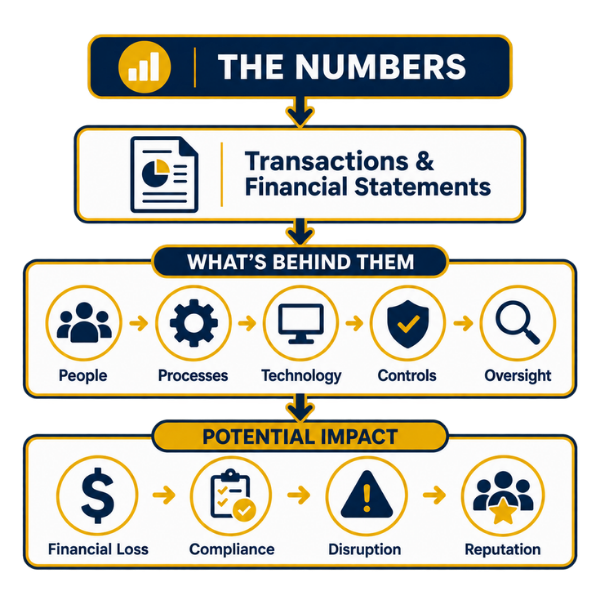
Financial statements can be accurate while the processes behind them still leave an organization exposed to risk. A payment may be recorded correctly, for example, but that doesn’t tell you whether the right person approved it, whether one employee had too much control over the transaction, or whether a change to a vendor’s banking information was independently verified. The same can be true for purchasing, payroll, contracts, grants, system access, and other everyday activities. These issues may not immediately make the financial statements wrong, but they can create opportunities for errors, fraud, financial loss, compliance problems, or reputational damage.
That’s where periodic financial and operational reviews can add another layer of protection. Instead of waiting for a control gap or inefficient process to become a costly problem, a review looks more closely at how the organization actually operates: who does what, where approvals happen, where responsibilities overlap, and where processes may no longer fit the organization’s size or complexity. The goal isn’t to find fault. It’s to identify the small gaps today that could become much bigger financial or operational problems tomorrow.
What Can This Look Like in the Real World?
These risks aren't theoretical. Small gaps in oversight, access, documentation, or accountability can exist quietly for years before becoming a significant financial or reputational problem.
Here are a few examples of what can happen when those gaps aren't identified early.
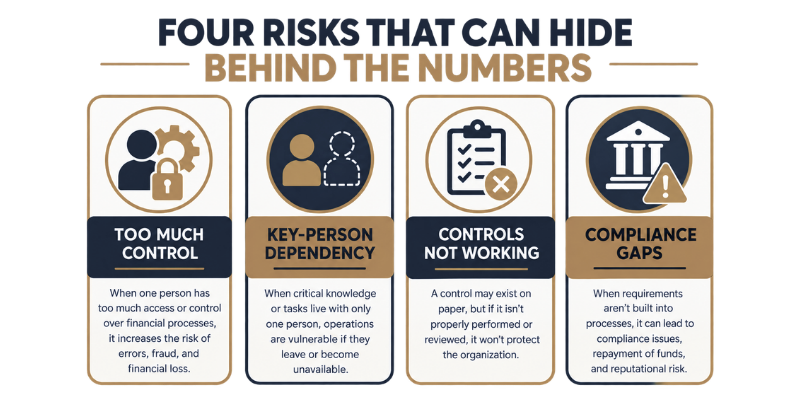
One Person Has Too Much Control
When one person has significant control over financial activity without enough independent review, an organization becomes more vulnerable to both errors and intentional misuse.
A recent Atlanta example demonstrates the risk. The former Senior Vice President of Finance for the Atlanta Hawks became the sole administrator of the organization's corporate credit card program and was the only employee with full visibility into cardholders, balances, and other program details. He ultimately embezzled millions of dollars from the organization.
The impact: Significant financial loss, a federal criminal case, and unwanted public attention for the organization.
The lesson: Efficiency is important, but no one person should have unchecked control over critical financial processes.
Too Much Knowledge Lives With One Person
"Ask Jennifer. She's the only one who knows how to do that."
It sounds harmless, but when payroll, billing, grant reporting, financial close, vendor management, or another critical process depends entirely on one employee, the organization has a vulnerability.
The impact: If that employee suddenly leaves or becomes unavailable, deadlines can be missed, operations can slow down, errors can increase, and leadership may find itself trying to reconstruct a process while keeping the business running.
The lesson: Critical processes should belong to the organization, not just the person performing them. Documentation, cross-training, and backup responsibilities can reduce that dependency.
A Control Exists, But It Isn't Working
Having a policy doesn't mean the policy is actually protecting the organization.
At one Washington, D.C. nonprofit, employees were required to document corporate credit card purchases and upload supporting invoices. Yet two employees were able to use the organization's card for unauthorized personal purchases and, in some cases, use false invoices to help conceal them.
The activity wasn't discovered until a new CFO questioned the unusually high volume of Amazon purchases. More than $393,000 had been stolen.
The impact: Hundreds of thousands of dollars in losses, employee terminations, criminal prosecution, and disruption to the organization.
The lesson: A control isn't effective simply because it exists. Someone still needs to review the activity, investigate exceptions, and ask, "Does this make sense?"
Compliance Problems Can Become Financial Problems
For nonprofits and grant-funded organizations, recording an expense correctly doesn't necessarily mean the expense meets the requirements of the funding source.
Federal auditors reviewing one nonprofit health center found weaknesses in how grant expenditures were tracked, reconciled, and documented. The problems were significant enough that auditors could not initially determine whether approximately $8 million in claimed costs were allowable, and they identified an additional $243,000 in unallowable costs.
More recently, a former executive director of a Santa Fe nonprofit agreed to pay $735,000 to resolve federal allegations involving conflicts of interest and ineligible claims connected to a HUD-funded housing program.
The impact: Potential repayment of funds, government scrutiny, additional corrective action, and reputational risk.
The lesson: Compliance needs to be built into the process from the beginning, not addressed only when an audit or monitoring review occurs.
Finding the Risks Before They Become Problems
A financial and operational review takes a closer look at how your organization actually works behind the numbers. It examines how money moves through the organization, who has access and approval authority, where responsibilities may be too concentrated, whether important processes depend on one person, and whether existing controls are actually working as intended. It can also identify areas where the organization has grown or changed, but its processes, policies, or oversight haven’t kept pace.
The value is finding vulnerabilities before they become expensive problems. A review can help leaders understand where they may be exposed to financial loss, compliance issues, operational disruption, or reputational damage and, more importantly, what can be done about it. The goal isn’t to create more policies or unnecessary layers of approval. It’s to identify the risks that matter, strengthen the areas that need attention, and give leaders greater confidence that the processes supporting their organization are as strong as the numbers they report.
A Clean Audit Shouldn't Be the End of the Conversation
A clean audit is something to value, but it can also be the beginning of another conversation: What else should we be looking at? Strong organizations don't wait for a financial loss, compliance issue, operational disruption, or damaging headline to start asking that question. They periodically look at how the organization actually works and address vulnerabilities while they are still manageable. Sometimes the most important risk isn't in the financial statements. It's in the process behind them.
For business owners, nonprofit executives, board members, and finance leaders: What risk have you encountered that wasn't obvious from looking at the financial statements alone? Share your experience in the comments. Your insight may help another leader ask a question they haven't considered yet.